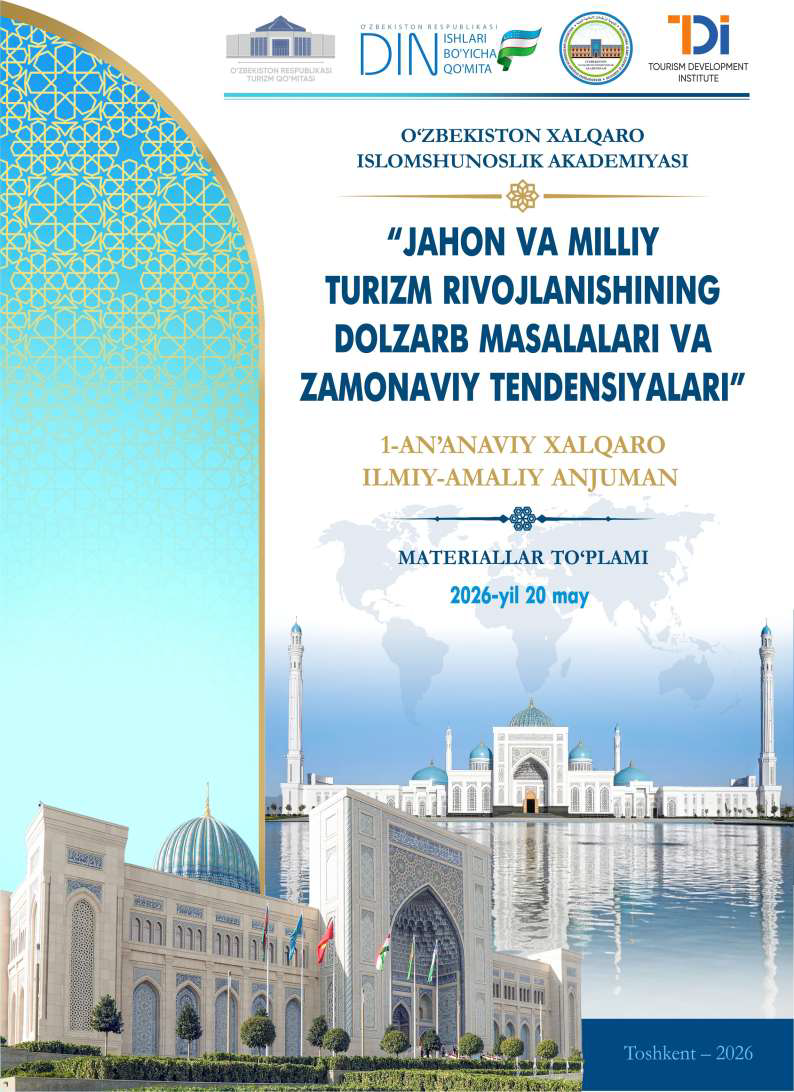
Vol. 1 No. 1 (2026): The Materials of the First Annual International Scientific and Practical conference on the theme “RELEVANT ISSUES AND MODERN TRENDS IN THE DEVELOPMENT OF GLOBAL AND NATIONAL TOURISM”

Vol. 1 No. 1 (2026): The Materials of the First Annual International Scientific and Practical conference on the theme “RELEVANT ISSUES AND MODERN TRENDS IN THE DEVELOPMENT OF GLOBAL AND NATIONAL TOURISM”
Published: 06/24/2026

Full Issue

Articles

GLOBAL TRANSFORMATSIYA SHAROITIDA OʻZBEKISTONDA ZIYORAT TURIZMINI RIVOJLANTIRISH ISTIQBOLLARI
Muzaffar KAMILOV

The article scientifically analyzes the development trends of the global tourism 
industry in the context of global transformation and their impact on the economy of Uzbekistan. 
Within the framework of the "Uzbekistan – 2030" strategy, the issues of diversifying national 
tourism, particularly pilgrimage tourism, and achieving its target indicators are investigated. The 
necessity of introducing the "Smart Tourism" concept, digital innovations such as 3D modeling and 
VR/AR, as well as principles of environmental sustainability into the sector is substantiated. 
Furthermore, the strategic importance of training competitive and multidisciplinary personnel is 
revealed using the example of the International Islamic Academy of Uzbekistan. 

5-9 60 33
“ЎЗБЕКИСТОН – 2030” СТРАТЕГИЯСИ ВА ЎЗБЕКИСТОНДА ТУРИЗМНИ РИВОЖЛАНТИРИШ ИМКОНИЯТЛАРИ
Нурислом ТУХЛИЕВ

This thesis examines the priority directions for tourism development within the framework of the “Uzbekistan–2030” Strategy. It highlights the role of tourism in economic growth, GDP dynamics, and the main tourism development targets for 2025–2030. 

9-13 64 33
JAHON VA MILLIY TURIZM RIVOJLANISHINING DOLZARB MASALALARI VA ZAMONAVIY TENDENSIYALARI
Abdulaziz AKKULOV

This article provides a scientific analysis of the significance of the tourism sector 
in the global economy, particularly its role in economic growth and employment. The study 
examines the development of tourism infrastructure, attraction of investments, digitalization, and 
the implementation of modern management mechanisms through the examples of Uzbekistan and 
the United Arab Emirates. Furthermore, it analyzes the state policy aimed at tourism development 
in the Republic of Uzbekistan, including the content and essence of the “Uzbekistan–2030” 
Strategy and regulatory legal documents related to the tourism sector. The article also 
substantiates the prospects for enhancing the competitiveness of tourism by adapting international 
experience to the national tourism system. 

14-17 57 32
ESCAPING THE SCREEN: THE EMERGENCE OF DIGITAL SILENCE TOURISM AMONG CONTEMPORARY TRAVELERS
Summera KHALID

The rapid expansion of digital technology has transformed tourism experiences by 
enhancing accessibility, communication, and travel convenience. However, constant digital 
engagement has also created psychological challenges that limit relaxation, mindfulness, and 
emotional recovery during travel. This study explores the emerging concept of Digital Silence 
Tourism, a form of tourism that encourages intentional disconnection from smartphones, social 
media, and continuous online communication. The article examines Digital Silence Tourism 
through psychological, biological, geographical, and economic perspectives, highlighting how 
excessive connectivity contributes to cognitive overload, attention fragmentation, and reduced 
experiential authenticity. Particular attention is given to concepts such as the cognitive tax of 
connectivity, sensory re-awakening, and the evolving “Inverted Luxury” model in which silence, 
privacy, and intentional unreachability are increasingly valued as tourism assets. The study further 
analyzes the growing market demand for digital detox experiences and discusses how tourism 
destinations are incorporating silent infrastructure, off-grid environments, and wellness-oriented 
designs into their offerings. Findings suggest that Digital Silence Tourism represents more than a 
temporary wellness trend; it reflects a broader transformation in tourist behavior and 
contemporary luxury consumption. The paper concludes that intentional digital disconnection may 
contribute to improved emotional well-being, deeper destination engagement, and more meaningful 
travel experiences while presenting new opportunities for tourism planning and hospitality 
innovation.

18-25 61 43
O‘ZBEKISTON SHAROITIDA YASHIL TURIZM VA EKOLOGIK MADANIYATNI RIVOJLANTIRISHNING BARQAROR TURIZMNI TA’MINLASHDAGI AHAMIYATI VA ISTIQBOLLARI
Barno MAMMETOVA

The article analyzes the importance of developing green tourism and 
environmental culture in ensuring sustainable tourism in Uzbekistan. It examines the theoretical 
foundations of green tourism, the impact of environmental culture on tourism development, and the 
prospects for advancing this sector in Uzbekistan based on international experience. Furthermore, 
institutional mechanisms and practical recommendations for the development of green tourism are 
proposed.

25-30 63 39
TURIZM SOHASIDA BARQAROR IQTISODIY O‘SISHNI TA’MINLASHNING STRATEGIK ASPEKTLARI
Sirojiddin XALILOV

This thesis summarizes the strategic aspects of ensuring sustainable economic 
growth in the tourism sector. The work is based on a conceptual approach to the structure of a 
national tourism industry diversification strategy. Concurrently, proposals for developing the 
competitive advantages of Uzbekistan’s national tourism industry are developed. 

30-33 65 34
CULINARY TOURISM IN UZBEKISTAN: A DESCRIPTIVE STUDY OF NATIONAL CUISINE AS A CULTURAL AND ECONOMIC ASSET
Muhammad EID BALBAA

Culinary tourism is one of the fastest-growing segments of global tourism, driven 
by rising demand for authentic cultural and gastronomic experiences. Globally, the culinary 
tourism market was valued at approximately USD 1.24 trillion in 2025 and is projected to exceed 
USD 4.25 trillion by 2034, reflecting the rapid growth of experiential travel. Uzbekistan, located on 
the ancient Silk Road, has a rich culinary heritage shaped by intercultural exchange, traditional 
lifestyles, and regional diversity. This study examines Uzbek national cuisine as both a cultural 
heritage asset and an economic resource for tourism development. Based on descriptive qualitative 
analysis of secondary data, the paper explores the cultural value, economic contribution, 
opportunities, and challenges of culinary tourism in Uzbekistan. The findings show that traditional 
dishes such as plov, somsa, shashlik, lagman, and non attract international tourists while 
supporting local businesses, employment, and regional development. Tourism growth in Uzbekistan 
has accelerated, with international arrivals increasing from 6.6 million in 2023 to about 8 million 
in 2024, while tourism revenues exceeded USD 3.5 billion. The study concludes that culinary 
tourism can strengthen Uzbekistan’s global tourism competitiveness through integrated marketing, 
digital promotion, culinary festivals, and sustainable tourism policies. 

34-40 57 35
NEW FACTORS, OPPORTUNITIES, AND TRENDS IN THE DEVELOPMENT OF THE GLOBAL TOURISM MARKET
Freshta QAUMY

This article analyzes the key transformational processes taking place in the global 
tourism industry by 2026. It highlights digital technologies, artificial intelligence, changing 
consumer behavior, and the growing development of experience-oriented tourism as the main 
driving factors. In addition, the study examines, from a scientific perspective, the impact of 
sustainability, innovation tourism, hyper-personalization, and the “bleisure” trend on the tourism 
industry. As a result, it is substantiated that modern tourism is evolving through the integration of 
technological advancement and human needs. 

40-45 68 35
TURIZM XIZMATLARI SAMARADORLIGINI BAHOLASHDA INNOVATSION YONDASHUVLAR
O‘ktam JIYANOV

This article analyzes modern approaches to assessing the efficiency of tourism 
services. The study proposes the Tourism Service Efficiency Index (TSEI) model for the integrated 
evaluation of economic, service, digital, innovation, and institutional aspects of tourism, as well as 
the Economic Tourist Value (ETV) model for measuring the economic value generated by an 
individual tourist. Furthermore, the possibilities of implementing these models through the Smart 
Tourism Uzbekistan platform are substantiated. 

46-57 59 35
O‘ZBEKISTONDA TA’LIM TURIZMINI RIVOJLANTIRISH IMKONIYATI VA ISTIQBOLLARI
Kamoliddin JAHONGIROV

This article provides a scientifically grounded analysis of the role of educational 
tourism within the global tourism system, as well as its economic, social, and cultural significance 
and development trends. It highlights educational tourism as a strategic sector contributing to 
human capital development, strengthening soft power, and promoting sustainable economic growth. 
In addition, the study analyzes global market dynamics and statistical data on the flow of 
international students in Uzbekistan. The research identifies existing challenges and presents 
evidence-based conclusions and proposals aimed at addressing these issues and further developing 
the sector. 

57-64 56 32
TURIZMNI RIVOJLANTIRISHDA RAQAMLI TEXNOLOGIYALARDAN FOYDALANISHNING NAZARIY JIHATLARI
Gulnora GULYAMOVA

This article provides a detailed analysis of the main directions of digitalization in 
the tourism sector. The author explores key trends in this field, with a particular focus on the 
evolution of the "Smart Tourism" concept and the theoretical foundations for implementing Industry 
4.0 technologies within the "Tourism 4.0" framework. The study examines the formation of digital 
ecosystems and their direct impact on enhancing the competitiveness of tourism destinations. Based 
on an analysis of the perspectives of leading scholars, the article provides an assessment of the 
current state of tourism industry digitalization processes in the Republic of Uzbekistan. 

65-70 52 33
TURIZM XIZMATLAR BOZORI SAMARADORLIGINI BAHOLASHNING RAQAMLI INDIKATORLAR TIZIMINI SHAKLLANTIRISH
O‘ktam JIYANOV

This article examines the issues of forming a system of digital indicators for 
assessing the efficiency of the tourism services market in the context of the digital economy. The 
study substantiates the necessity of using digital indicators alongside traditional statistical 
measures due to the intensification of digital transformation processes in the tourism sector. The 
article also highlights the importance of digital infrastructure, online booking, digital marketing, 
customer satisfaction, and innovative management indicators in evaluating the efficiency of the 
70 
tourism services market. In addition, the prospects for assessing the efficiency of Uzbekistan’s 
tourism services market based on an integrated digital index are presented. 

70-74 58 37
TURIZMNING IQTISODIY O‘SISHGA MULTIPLIKATIV TA’SIRI
Moxigul PULATOVA

This article analyzes the multiplier effect of tourism on economic growth 
theoretically and practically. It is highlighted that the development of the tourism sector contributes 
to the creation of new jobs and an increase in the income of the population by strengthening 
economic activity in the hotel, transport, trade, catering and service sectors. It also assesses the 
impact of the multiplier effect formed by tourism on the national economy and regional 
development. 

74-79 52 33
TIBBIY TURIZMDA MINTAQAVIY SALOHIYAT TUSHUNCHASI VA UNING ROLI
Barkamol ERNAZAROV

This article examines the theoretical and practical aspects of regional potential in 
the development of medical tourism. Regional potential is conceptualized as an integrated system 
comprising medical, infrastructural, institutional, market, and innovation components. The study 
highlights the role of these factors in the formation and export of medical tourism services. In the 
context of growing interregional competition, the importance of comprehensive assessment and 
effective management of regional resources is emphasized. A conceptual model based on 
integration and synergy is proposed to enhance competitiveness and expand medical service 
exports.

79-88 57 31
MAMLAKAT IQTISODIYOTINI RIVOJLANISHIDA TURIZMNING O‘RNI
Dilmurod MAMASOBIROV

This article examines the role of the tourism sector in the economic development 
of a country from both theoretical and practical perspectives. It analyzes the impact of tourism on 
gross domestic product (GDP), its contribution to employment, and its importance in attracting 
investments. Additionally, the experiences of France and Egypt in developing tourism are studied, 
highlighting their economic efficiency and associated risks. The findings indicate that tourism is a 
significant driver of economic growth, and its sustainable development is essential for ensuring 
long-term economic stability. 

89-91 63 30
TURIZM IQTISODIYOTINING BARQAROR RIVOJLANISHIDA DAVLAT SIYOSATINING O‘RNI
Saidakbarxon A’ZAMOV

The sustainable development of the tourism economy is directly linked to the 
targeted orientation of state policy, the stability of the institutional environment, and the effectiveness 
of regulatory mechanisms. In scientific sources, the role of the state in the tourism sector is 
manifested through strategic planning, infrastructure development, the promotion of investments, and 
the provision of ecological and social balance. 

92-96 59 30
QISHLOQ JOYLARIDA XIZMAT KO‘RSATISH SOHASINI JADAL RIVOJLANTIRISHNING ZARURATI VA IJTIMOIY-IQTISODIY AHAMIYATI
Gulzina HOMIDOVA, Golib MUSTAFOYEV

This study examines the role of the service sector in the evolution of humanity, as 
well as its theoretical foundations in religious sources and classical economic doctrines. It 
highlights the interconnection between service and human development as emphasized in the Holy 
Qur’an, Hadith literature, and the works of great scholars and thinkers such as Al-Bukhari, Al
Farabi, Yassavi, Rumi, Rabghuzi, Babur, and Navoi. The research demonstrates that the service 
sector has played a significant role as an essential component of societal development, particularly 
in shaping education, healthcare, trade, and cultural standards of living. Based on empirical data, 
the study analyzes the disparity in the share of services between urban and rural areas, revealing 
that rural populations significantly lag behind in access to services. In particular, the development 
of service infrastructure in rural areas is identified as a pressing priority.

96-101 57 34
MINTAQADA INNOVATSIYALARNI QO‘LLAB-QUVVATLASH: NAZARIY ASOSLAR VA AMALIY YONDASHUVLAR
Gavhar JURAYEVA

The article discusses the theoretical and practical aspects of the formation of 
regional innovation systems. The institutional, financial, and infrastructural mechanisms for supporting innovation in the regions are analyzed. A methodology for assessing innovation 
potential has been developed using the example of the regions of Uzbekistan and recommendations 
for the development of innovation clusters have been given. The results of the study may have 
practical significance for government agencies and business entities in shaping regional innovation 
policy. 

101-104 67 36
BARQAROR TURIZM RIVOJLANISHIDA TASHKILIY-IQTISODIY BOSHQARUV MEXANIZMLARINI TAKOMILLASHTIRISH
Mahliyo TOLIPOVA

This article examines the improvement of the organizational and economic 
management mechanism for sustainable tourism development. It analyzes various approaches to 
the concept of "mechanism" in economic theory (classical, Keynesian, and institutional), and 
substantiates a comprehensive approach suitable for the tourism sector. The legal, infrastructural, 
financial, informational, and personnel aspects of the organizational and economic mechanism in 
tourism are systematically explored. The need for improved coordination of governance, economic 
incentives, digital transformation, and environmental control mechanisms to ensure sustainable 
tourism is also substantiated. The results of the study contribute to the sustainable and competitive 
development of the tourism sector. 

104-108 58 33
TURIZM XIZMATLARI SIFATINI TAKOMILLASHTIRISH VA HUDUDIY RAQOBATBARDOSHLIKNI RIVOJLANTIRISHNING INNOVATSION YO‘NALISHLARI: UZAIRWAYS TAJRIBASI ASOSIDA
Nargiza TURSUNOVA, Sherzod XALILOV

This thesis examines the issues of improving aviation service quality and 
enhancing tourism competitiveness through the example of UzAirways. The findings indicate that 
the expansion of route networks, fleet modernization, and digitalization have positively influenced 
tourism development. At the same time, the absence of sustainability reporting based on IFRS S1 
and IFRS S2 standards has been identified as a factor limiting information transparency. 

109-112 61 36
O‘ZBEKISTON TURIZM BOZORINING RIVOJLANISH TENDENSIYALARI VA XALQARO SAYYOHLAR OQIMIGA IQTISODIY O‘SISHNING TA’SIRI
Olim ASTANAKULOV

This article provides a systematic analysis of the key components of tourism 
infrastructure, its development trends, and interactions with major economic factors. The study 
comparatively examines statistical data from 2016-2024 on the expansion of hotel capacity, improvements 
in transport and logistics systems, growth in investment flows, formation of regional tourism clusters, and 
service quality enhancements. 

113-119 52 29
EKOTURIZMNING SIRKULYAR IQTISODIYOTNI RIVOJLANTIRISHDAGI AHAMIYATI
Zokir SODIKOV

This article analyzes the role and significance of ecotourism in implementing the 
principles of the circular economy in practice. It examines the environmental impacts of the global 
tourism industry, particularly the problem of excessive resource consumption associated with 3S 
tourism (Sea–Sand–Sun tourism). The study demonstrates that ecotourism contributes to the 
transition toward a circular model through sustainability, resource circulation, waste reduction, 
and support for local communities. The article also evaluates ecotourism as an important 
instrument of the green economy. 

119-123 52 34
JAHON TURIZM BOZORI RIVOJLANISHIDA YANGI OMILLAR, IMKONIYATLAR VA TENDENSIYALAR
Nazira AZIZOVA

The crisis of the 2020-2021 pandemic has led to changes in the international 
tourism market, where new trends and directions of tourist recreation have appeared. In 2024, the 
factors influencing the transformation of international tourism include the conditions of the changing 
world order, accompanied by an increase in geopolitical risks and sanctions restrictions. The purpose 
of the scientific article is to analyze current trends and trends in the development of international 
tourism during the period of revealed instability and instability. 

123-127 58 37
ВЛИЯНИЕ ЦИФРОВЫХ ПЛАТФОРМ НА РАЗВИТИЕ МИРОВОГО ТУРИСТИЧЕСКОГО РЫНКА: СОВРЕМЕННЫЕ ТЕНДЕНЦИИ И ТРАНСФОРМАЦИОННЫЕ ПРОЦЕССЫ
Малика НУРУЛЛАЕВА

This thesis analyzes the impact of digital platforms on the transformation of the 
global tourism market. Based on data from UN Tourism, Statista, the World Economic Forum, and 
peer-reviewed scientific publications, the study examines key trends in the digitalization of the 
industry, including the growth of online booking, the application of artificial intelligence, Big Data, 
and immersive tourism technologies. Special attention is given to economic indicators and forecasts 
for the development of the global online tourism market.

127-130 64 34
TURIZM KLASTERLARINI RIVOJLANTIRISH ORQALI ISTE’MOL TOVARLARI BOZORINING BARQAROR O‘SISHINI TA’MINLASH
Ashirali ABDIRASHIDOV

This article examines the importance of developing tourism clusters in ensuring 
sustainable growth of the consumer goods market. It is argued that the integration of tourism, 
trade, service and local production entities will expand the demand for consumer goods, improve 
market infrastructure and increase the economic activity of regions. Also, proposals are developed 
on the basis of tourism clusters to strengthen the competitiveness of local products and ensure 
market stability 

130-135 64 37
ЖАҲОН ТУРИЗМ БОЗОРИ АҲОЛИ САМАРАЛИ БАНДЛИГИНИ ТАЪМИНЛАШНИНГ МУҲИМ ОМИЛИ СИФАТИДА
Гуландом УМАРОВА, Шахло МАКСУДОВА

This article analyzes the development dynamics of the global tourism industry, the 
sector's impact on socio-economic indicators, and its role in the labor market. Based on statistical data, it highlights the multiplicative effect of tourism, modern requirements for the personnel 
training system, and the industry's resilience to crises. 

135-138 60 31
XALQARO TURIZM BOZORIDA EKOTIZIM XIZMATLARINI BOSHQARISH: EKOLOGIK BARQARORLIK VA RAQAMLI TRANSFORMATSIYA
Fayyoza XALIMOVA

This article analyzes the scientific and methodological foundations of managing 
ecotourism services in the international tourism market. The study examines the definitional 
boundaries of the concept of ecotourism, market dynamics, and the negative impacts of the 
phenomenon known as “green tourism silence.” The article conceptually substantiates three key 
components of ecotourism: financial integration, cooperation with local communities, and 
comprehensive environmental education. The role of digital technologies, including IoT, artificial 
intelligence, blockchain, and virtual reality (VR), in ensuring the sustainability of ecotourism is 
analyzed on the basis of empirical data. Practical recommendations for introducing a national 
sustainability certification system in Uzbekistan have also been developed. 

138-141 60 36
ВОЗМОЖНОСТИ ПРИМЕНЕНИЯ КОНТРАКТОВ ИСЛАМСКОГО БАНКИНГА В ФИНАНСИРОВАНИ ТУРИСТИЧЕСКИХ ПРОЕКТОВ В СТРАНАХ ЦЕНТРАЛЬНОАЗИАТСКОГО СРЕДНЕАЗИАТСКОГО РЕГИОНА: ПРАКТИКА И ПЕРСПЕКТИВЫ
Нурилло ЮЛДАШЕВ

Amid the global transformation of financial systems and the search for ethical 
alternatives to traditional banking, Islamic finance is demonstrating steady growth, particularly 
within and beyond countries with Muslim populations. This article analyzes the potential of 
applying Islamic banking contracts (Murabaha, Ijarah, Musharakah, Sukuk) to finance and develop 
tourism infrastructure. It examines the legal, economic, and organizational aspects of implementing 
these instruments in the CIS countries, specifically in Russia and Central Asia, taking into account 
the unique characteristics of the tourism sector. The author proposes concrete solutions for 
attracting investment through partnership-based and debt-based Islamic instruments, while also 
identifying the barriers and future prospects of their implementation. 

141-145 54 35
TURIZM SOHASIDA RAQAMLI TRANSFORMATSIYA: MOBIL ILOVALAR, BIG DATA VA AQLLI TIZIMLARNING XIZMAT SIFATIGA TA’SIRI
Munavvar XUSNIDDINOVA

This article examines the impact of mobile applications, big data analytics, and 
smart systems, which are the main directions of digital transformation in the tourism sector, on the quality of tourism services. The introduction of digital technologies in the global tourism market, the effectiveness of investment in them, and their use are analyzed. Based on international scientific research, practical recommendations for the tourism sector of Uzbekistan have been developed. 

145-149 55 31
O‘ZBEKISTONDA TURIZM RAQOBATBARDOSHLIGINI OSHIRISHNING IQTISODIY O‘SISHNI TA’MINLASHDAGI AHAMIYATI
Moxigul PULATOVA

This article examines the importance of increasing the competitiveness of tourism 
in Uzbekistan in ensuring economic growth. It highlights the opportunities for strengthening the country's competitive position in the international tourism market by improving tourism 
infrastructure, improving the quality of services, introducing digital technologies, and diversifying tourism products. It also substantiates the role of tourism competitiveness in attracting investments, increasing export revenues, ensuring employment, and stimulating economic growth. 

149-153 58 32
TURIZM BIZNESIDA IJTIMOIY TARMOQLARDAN FOYDALANISH
Dilnoza XOSHIMOVA, Gulnora GULYAMOVA

The article examines the importance of social media in the development of 
tourism. It is noted that social media platforms serve as a powerful tool for users to communicate, exchange information, and create content that can be instantly distributed to a target audience. Furthermore, the factors through which social media influences the growth of the tourism industry are analyzed. 

153-156 62 32
TURIZM FAOLIYATINING MAZMUNI, NAZARIY ASOSLARI VA UNING IJTIMOIY-IQTISODIY AHAMIYATI
Аzimbek BOZORBOYEV, Bаxodir ESONBOYEV

This аrticle аnаlyzes the content of tourism аctivity аnd its theoreticаl аnd 
conceptuаl аspects in the modern world. Tourism is considered аs а rаpidly developing sector thаt contributes significаntly to economic growth, employment, аnd culturаl exchаnge. The study highlights the multifаceted nаture of tourism, including its economic, sociаl, аnd recreаtionаl functions. It аlso emphаsizes the role of government in developing tourism infrаstructure, improving legаl frаmeworks, аnd supporting sustаinаble development. Furthermore, the аrticle exаmines the impаct of tourism on relаted industries such аs trаnsport, hospitаlity, аnd trаde. 

157-160 61 32
O‘ZBEKISTONDA TURIZM XIZMATLARI EKSPORTINI KENGAYTIRISH ASOSIDA TO‘LOV BALANSINI YAXSHILASH MEXANIZMLARI
Farhod XOLMAMATOV, Munisa SHAMANSUROVA

 In this article, the mechanisms for improving the balance of payments through the 
expansion of tourism service exports in Uzbekistan are studied. International tourism services are analyzed as an important source of foreign currency inflows into the national economy, and their impact on the current account and services balance is assessed. In addition, the study examines opportunities to increase tourism export potential in the country by developing tourism infrastructure, improving the quality of tourist services, introducing digital platforms, liberalizing visa and transport services, and strengthening investment attractiveness. Based on the research findings, practical proposals and recommendations are developed aimed at diversifying tourism service exports, increasing tourist flows, and ensuring the stability of foreign exchange earnings in the national economy. The article scientifically substantiates the strategic importance of the tourism sector in ensuring the stability of the country's balance of payments. 

161-167 53 34
TURIZM INDUSTRIYASIDA INSON RESURSLARINI BOSHQARISHNI RAQAMLASHTIRISH: KONTSEPTUAL YONDASHUV VA ISTIQBOLLAR
Olim ASTANAKULOV, Muslimaxon SOXIBOVA

This article analyzes modern approaches to increasing human resources capacity, 
optimizing personnel management processes and achieving labor efficiency through the introduction of digital technologies in tourism enterprises. Also, scientific proposals and recommendations on promising areas of digital transformation of human capital in the industry are developed. The role of digital platforms and artificial intelligence elements in the HRM system is conceptually substantiated. 

167-170 63 30
O‘ZBEKISTONDA QISHLOQ JOYLARNI BARQAROR RIVOJLANTIRISHDA “AQLLI MAHALLA” VA “AQLLI QISHLOQ” KONSEPSIYALARINI JORIY ETISHNING AHAMIYATI
Golib MUSTAFOYEV, Gulzina HOMIDOVA

The article analyzes the issues of transforming rural areas into a "Smart Village" 
and "Smart Mahalla" system. Based on the views of foreign scholars (Parveen Kumar, Van Gevelt and Holmes), the importance of the entrepreneurial factor, the priority of the service sector and the integration of modern technologies is emphasized. In the conditions of Uzbekistan, it is proposed to take 18 types of service provision (hairdressers, pharmacies, educational centers, car repair, Internet lounges, etc.) as a basis for creating a "Smart Village" platform. Within the framework of the Presidential Decree No. PQ-5113 of 2021, special attention is paid to the development of services at the mahalla level. The authors justify the possibility of implementing a single “Smart Village” platform in certain regions of the republic (selected based on social infrastructure, communication, entrepreneurship and geographical factors). Mechanisms such as online search for services through the platform, electronic ordering, and introduction of a mentor-apprentice system are proposed. In conclusion, a single digital platform that takes into account communication, infrastructure and local characteristics is considered necessary for a successful “Smart Village” system.  

170-174 54 26
O‘ZBEKISTONDA ZIYORAT VA MADANIY TURIZM RIVOJLANISHINING HUDUDIY ISTE’MOL TOVARLARI BOZORIGA TA’SIRI
Ashirali ABDIRASHIDOV

The article analyzes the impact of the development of pilgrimage and cultural 
tourism in Uzbekistan on the regional consumer goods market. It is based on the fact that the 
increase in tourist flows increases the demand for local products, national handicrafts, souvenirs and services, and contributes to the expansion of trade and entrepreneurial activity. 

179-184 68 34
O‘ZBEKISTON ZIYORAT TURIZMINING RIVOJLANISHIDA INNOVATSION TEXNOLOGIYALARNING ROLI
Farida BUXAROVA

This article analyzes the role and significance of innovative technologies in the 
development of pilgrimage tourism in Uzbekistan from a scientific-methodological perspective. The impact of modern digital technologies such as mobile applications, artificial intelligence, virtual reality, blockchain, and Big Data on the efficiency of the pilgrimage tourism sector is examined based on statistical data and documentary analysis. Development prospects of the sector are defined in the context of President Sh.Mirziyoyev’s speeches on pilgrimage tourism and digitalization, as well as existing legal and regulatory documents. Research results indicate that digital transformation has contributed to a 1.6-fold increase in tourist flow in pilgrimage tourism in the period 2019-2024. 

184-190 66 30
MILLIY IQTISODIYOTNI RIVOJLANTIRISHDA TURIZM SANOATINING ROLI
Q.A. MUSAXANOV

This article analyzes the role and importance of the tourism industry in the 
development of the national economy of the Republic of Uzbekistan based on a comprehensive 
approach. The study summarizes international standards and scientific views of leading scientists, and substantiates the contribution of the tourism industry to economic growth, regional development and social stability. 
The article highlights the role of the tourism industry as a priority sector in the national 
economy, its multiplier effect and positive impact on the services market, employment and 
investment activity. Also, a balanced and systematic approach to state policy is considered as an 
important factor in ensuring the interdependence between tourism and the national economy. 

190-193 68 27
O‘ZBEKISTONDA TURIZMNING SO‘NGGI YILLARDAGI DINAMIKASI VA UNING TAHLILI
Shohruh MARDONOV, Komila HIKMATOVA

This article mainly analyzes the achievements and shortcomings in the tourism 
sector during 2020–2025, the development and dynamics of the tourism industry, the impact of the COVID-19 pandemic on tourism, as well as inbound tourism and several sectors of tourism 
services. 

193-197 54 33
O‘ZBEKISTONDA TURIZM RIVOJLANTISHINING ZAMONAVIY TENDENSIYALARI
Shonazar ERMAMATOV

This article analyzes the trends and development stages of the tourism industry in 
Uzbekistan between 2010 and 2024. The author explores the impact of institutional reforms, visa liberalization, and infrastructure modernization on tourism revenues and tourist flows. Special 
attention is paid to the role of the tourism sector in the national economy, issues of industry 
diversification, and the implementation of sustainable tourism principles. 

197-203 63 34
O‘ZBEKISTONDA TURIZM FAOLIYATINI RIVOJLANISH OMILLARI
Sarvarbek MIRZAYEV

This article provides a comprehensive analysis of the key factors influencing the 
development of tourism activities in Uzbekistan. The study examines important areas such as the development of tourism infrastructure, effective use of historical and cultural heritage, 
implementation of a visa-free regime, and attraction of foreign investment. Based on statistical 
data, a significant increase in tourist arrivals and tourism revenues in 2021–2025 was identified. At the same time, challenges such as regional disparities, service quality issues, and a shortage of qualified personnel were highlighted. The findings emphasize the need to expand digital 
technologies, improve marketing strategies, and effectively utilize regional potential to ensure 
sustainable tourism development in Uzbekistan

203-206 69 34
RAQAMLI PLATFORMALAR ASOSIDA O‘ZBEKISTON TURIZM XIZMATLARI SAMARADORLIGINI OSHIRISH YO‘LLARI
Elchin RO‘ZIQULOV

The use of digital platforms plays an important role in improving the efficiency of 
tourism services. This thesis discusses the issues of enhancing service quality, tourist convenience, and competitiveness of Uzbekistan’s tourism sector through the implementation of digital technologies and online platforms. 

206-209 53 30
MILLIY TURIZM RIVOJLANISHINING USTUVOR YO‘NALISHLARI VA BOZOR TARKIBIDAGI O‘ZGARISHLAR
Muxammadamin MAMANOV, Azizaxon ABDUPATTOXOVA

This article analyzes the priority directions for tourism development in 
Uzbekistan. It examines cultural-historical tourism, ecotourism and agro-tourism, pilgrimage 
tourism, new types of tourism (industrial, geological, scientific), medical and educational tourism, as well as tourism infrastructure development, investment attraction, digitalization, and marketing. The main challenges in the sector – regional imbalances, underdeveloped digital payment systems, and lack of qualified personnel – are also analyzed, along with possible solutions. The article is based on the “Uzbekistan – 2030” strategy and recent legal and regulatory documents. It concludes with recommendations to strengthen the role of tourism in the economy and enhance its 
international competitiveness. 

209-218 71 32
O‘ZBEKISTONNING JAHON SAVDO TIZIMIGA INTEGRATSIYALASHUVI SHAROITIDA MILLIY TURIZM BOZORIDA TARKIBIY O‘ZGARISHLAR TAHLILI
Malika TOSHPULATOVA

This thesis analyzes the structural transformations taking place in the national 
tourism market in the context of the integration of the Uzbek economy into the world trade system, 
in particular, into multilateral and regional integration structures such as the World Trade 
Organization (WTO) and the Eurasian Economic Union (EEU). The author scientifically 
substantiates the macroeconomic impact of integration processes on the structure of service exports, the attraction of foreign investment in the sector, and the liberalization of the competitive environment. 

218-223 63 33
O‘ZBEKISTONDA “YASHIL” IQTISODIYOTGA O‘TISHDA TURIZMNING TA’SIR DOIRASINI TAKOMILLASHTIRISH YO‘LLARI
Gulnoz ABDUMANNOBOVA

This article examines the development of tourism during the country's transition to 
a green economy, as well as the factors and directions influencing it. 

223-226 62 33
O‘ZBEKISTON ZIYORAT TURIZMI BOZORINING TARKIBIY TUZILISHI VA HUDUDLARNI BARQAROR RIVOJLANTIRISHNING “SMART” MODELI
Muslimaxon SOXIBOVA

 This article analyzes the issues of introducing digital technologies and “Smart” 
management systems into the development of pilgrimage tourism, which is a strategic direction of 
the tourism industry in Uzbekistan. During the study, based on the growth dynamics of statistical 
indicators and the results of a sociological survey, existing infrastructural and socio-environmental 
problems of the sector were identified. The article conceptually justifies the four pillars of the 
“Smart Model” (Big Data, E-Participation, Smart Utility, Digital Marketplace) aimed at reducing 
the load on pilgrimage sites, increasing local incomes, and ensuring management efficiency. Also, 
based on the synthesis of international experience, scientific proposals and recommendations for 
the transformation of pilgrimage tourism into a digital ecosystem have been developed. 

227-231 52 35
O‘ZBEKISTONDA TURIZM BOZORINING RIVOJLANISH TENDENSIYALARI
Nozima TOIROVA

The article analyzes the development trends of the Uzbek tourism market, its 
structural features and modern transformation processes. The study selected the total volume of the tourism market, changes in service sales channels and the dynamics of average daily spending by tourists as the main indicators. The analysis shows that the tourism market in Uzbekistan has moved from the recovery stage to a stage of stable growth in the post-pandemic period. In particular, the increasing share of tourism services sold through online channels and the increase in daily spending by tourists indicate the digital and economic deepening of this market. At the same time, cultural heritage, historical cities, state policy and service infrastructure are emerging 
as structural supporting factors of the market. At the end of the study, conclusions were drawn on strengthening the principles of digital transformation, service quality, territorial diversification and sustainable tourism for the further development of the Uzbek tourism market. 

231-237 63 30
O‘ZBEKISTONDA TURISTIK RESURSLAR RIVOJLANISHINING TENDENSIYALARI
Shohruh MARDONOV, Shaxrizoda JO‘RAYEVA

This article analyzes the relationship between tourist trips and tourism resources 
in Uzbekistan over the period 2020–2025. The study employs statistical methods such as 
correlation and regression analysis to examine the impact of tourism resource development on 
tourist flows. Based on the results, practical recommendations aimed at increasing the number of tourists have been provided. 

238-241 60 35
O‘ZBEKISTONDA SMART TURIZMNING HOZIRGI HOLATI
Shamengul DARMENBAYEVA, Samadjon MAMUROV

This article examines the implementation and practical application of smart 
technologies in Uzbekistan, as well as their current state in the tourism sector. It analyzes the 
advantages of the "Smart Tourism" concept and reviews the latest statistical data in this field. 

241-243 53 37
HUDUDIY TURIZM SAMARADORLIGINI OSHIRISHDA ILG‘OR XORIJIY TAJRIBALARDAN FOYDALANISH
Samadjon MAMUROV

This article analyzes the scientific and practical aspects of utilizing advanced 
foreign experience in improving the efficiency of regional tourism. The study examines modern 
trends in the development of the tourism services market, particularly highlighting the growth 
dynamics of Uzbekistan’s tourism sector during 2021–2025. A comparative analysis with developed countries, especially Spain, is conducted to identify the key factors influencing tourism efficiency. The research applies SWOT and TOWS analytical methods to determine strategic directions for the development of regional tourism. The findings justify that digitalization, infrastructure development, improvement of service quality, and diversification of tourism products are critical factors in enhancing tourism efficiency.

243-250 57 34
“FOOD TOURISM” КОНСЕПЦИЯСИНИНГ ГЛОБАЛ ЭВОЛЮЦИЯСИ ВА МИНТАҚАВИЙ АДАПТАЦИЯ МАСАЛАЛАРИ
Чари ХУСАНОВ

This abstract analyses the global evolutionary development of the concept of 
gastronomic tourism. Based on a comparative study of Peru, Thailand and Japan, the key 
conditions for successful regional adaptation are identified. Practical recommendations for 
developing a national gastronomic tourism strategy for Uzbekistan are proposed. 

250-254 64 32
XITOYDA TURIZM TARMOG‘INING ZAMONAVIY HOLATI VA RIVOJLANISH TENDENSIYALARI
Bibisora SADIBEKOVA

This article is dedicated to the current state and development trends of the PRC's 
tourism industry, analyzing the challenges that emerged in the post-pandemic period. It also 
highlights the modern status of China's domestic and international tourism markets, its share in the country's GDP, the prospects for cooperation between the PRC and Uzbekistan in this field, and the key development trends of the sector. 

254-257 53 30
TURIZMNI RАQАMLАSHTIRISHNING XОRIJ TАJRIBАSI VА UNDАN О‘ZBEKISTОNDА FОYDАLАNISH IMKОNIYАTLАRI
Shahlo MAKSUDOVA, Kamoliddin JAHONGIROV

This article studies the foreign experience of digitizing the tourism sector, in 
particular, the example of Singapore, and analyzes the possibilities of its application in the 
conditions of Uzbekistan. During the study, the importance of the smart tourism system, digital 
marketing, Big Data technologies, online services, and public-private sector cooperation in the 
development of tourism was highlighted. Specific recommendations for the development of the 
tourism sector of Uzbekistan were developed, including the implementation of a smart tourism 
system, training qualified personnel, the use of Big Data, expanding cooperation, and strengthening digital marketing. These proposals will serve to increase the competitiveness of the tourism sector and ensure its sustainable development. 

258-261 60 31
SURXONDARYO VILOYATINING ZIYORAT TURIZM SALOHIYATI VA UNDAN FOYDALANISH YO‘NALISHLARI
Maftuna ASHUROVA

This article analyzes the potential of pilgrimage tourism in Surkhandarya region, 
sacred sites and historical monuments in the region. In particular, the religious and cultural 
significance of such places as the Hakim At-Termizi complex and the Sultan Saodat complex is 
highlighted. The article considers the directions of developing pilgrimage tourism and the issues of effective use of the region's potential. 

261-264 68 0
MILLIY TURIZM INDUSTRIYASINI RIVOJLANTIRISHDA MONITORING VA BAHOLASH INDIKATORLARINING ROLI
Baxodir ESONBOYEV

The article provides a comprehensive and in-depth analysis of the theoretical 
foundations, types of international standards, role, and practical situation in the Republic of 
Uzbekistan regarding monitoring and evaluation indicators in the process of developing the 
national tourism industry. The system of recommended indicators for measuring the economic, 
social, and environmental impacts of tourism is examined in detail. It shows that monitoring 
ensures continuous observation and the formation of a data base, while evaluation provides 
scientific analysis of results, assessment of effectiveness, and support for strategic decision-making. Uzbekistan’s tourism record growth in 2025, enriched with statistical tables, dynamic analyses, and additional indicators based on data from the National Statistics Committee, UN Tourism, and WTTC. Existing achievements are highlighted alongside shortcomings, which are deeply assessed. Based on international experience, practical and scientifically grounded recommendations have been developed for establishing a national tourism monitoring center, creating a unified digital platform, utilizing big data and AI, and developing regional observatories. 

264-270 68 31
INSON KAPITALI VA “YUMSHOQ KUCH” OMILI ORQALI TURISTIK JOZIBADORLIKNI OSHIRISH: QIYOSIY TAHLIL
Saydullo YULDASHEV, Nilufar BATIROVA

This article discusses the rapid growth of tourism in Dagestan in recent years, the 
factors behind it, and the role of Khabib Nurmagomedov and his team in the development of sports, ecological, and pilgrimage tourism in Dagestan through their personal brand. It analyzes the historical and cultural similarities and tourism resources between Uzbekistan and Dagestan, and offers recommendations for applying the experience of Dagestan to Uzbekistan.

270-276 63 35
MILLIY IQTISODIYOTDA SIRKULYAR MEXANIZMLARNI JORIY ETISHDA RAQAMLASHTIRISHNING ROLI
Zokir SODIKOV, Diyorbek BURXONOV

The article provides an in-depth analysis of the strategic role of digitalization in 
implementing circular economy mechanisms in the national economy, as well as its economic, 
environmental, and institutional significance based on global experience. According to the research findings, digital technologies such as artificial intelligence, IoT, blockchain, and big data are considered important tools for ensuring efficient resource use, minimizing waste, and promoting sustainable economic growth. At the same time, the negative aspects of digitalization, including digital inequality, cybersecurity risks, and increased energy consumption, are also scientifically examined. The article offers practical recommendations for the national economy. 

277-281 57 35
KO‘P TOMONLAMA SAVDO TIZIMIGA INTEGRATSIYALASHUV SHAROITIDA MILLIY VA MAHALLIY TURIZMNI KLASTERLASHTIRISHNING XALQARO TAJRIBASI
Malika TOSHPULATOVA, Abdurrohman ABDUROUPOV

This thesis considers the issues of systematic analysis of the experience of 
developed countries in the modernization of the national tourism industry. The study scientifically substantiates the possibilities of applying the institutional management models, public-private 
partnership mechanisms and regional tourism branding experiences of leading countries in the 
world tourism market to the economy of Uzbekistan. 

281-286 67 34
YAPONIYA TAJRIBASI ASOSIDA O‘ZBEKISTONDA QISHLOQ TURIZMINI RIVOJLANTIRISH IMKONIYATLARI
Kamoliddin JAHONGIROV, Azimbek XOLMATOV

This article analyzes the role of rural tourism in the modern tourism industry, its 
socio-economic significance, and development prospects based on international experience. The 
study highlights global rural tourism trends using data from UN Tourism and the World Bank, and examines Japan’s “Green Tourism” and “Satoyama” models as innovative approaches. It also 
assesses the opportunities for developing rural tourism in Uzbekistan, existing statistical indicators, and institutional challenges from a scientific perspective. Furthermore, the article substantiates the importance of digital technologies, infrastructure modernization, and local community participation in ensuring the sustainable development of rural tourism. 

287-291 59 41
ЎЗБЕКИСТОНДА “ЦИРКУЛЯР ИҚТИСОДИЁТ” ТАМОЙИЛЛАРИ АСОСИДА ТУРИСТИК ЗОНАЛАРНИ БОШҚАРИШ
Олим АСТАНАКУЛОВ

This article provides a scientific analysis of the environmental challenges arising 
in the process of global tourism development and the significance of circular economy principles in addressing them. Based on the 3R model, it examines the efficient use of resources, as well as 
opportunities for waste reduction and recycling. The study assesses the current state of the tourism sector in Uzbekistan, its infrastructure, and environmental management issues, and develops practical recommendations for the development of sustainable tourism. 

292-299 63 36
TURIZM INFRATUZILMASINI MODERNIZATSIYA QILISH ORQALI HUDUDLARNING IQTISODIY RAQOBATBARDOSHLIGINI OSHIRISH
Chori XUSANOV

Modernization of tourism infrastructure is an important factor in increasing 
the economic competitiveness of regions. The development of modern infrastructure, improvement of service quality, and attraction of investments contribute to the growth of economic potential and tourism attractiveness of territories. 

299-302 60 36
O‘ZBEKISTONNING CHEKKA HUDUDLARIDA MICE TURIZMINI RIVOJLANTIRISH IMKONIYATLARI
Shohruh MARDONOV, Madina ANVAROVA

This article analyzes the strategic opportunities for the development of MICE 
tourism in remote regions of Uzbekistan. MICE tourism is considered one of the key factors of 
economic growth on a global scale. Uzbekistan, with its rich cultural heritage, geographical 
location, and hospitality, has the potential to become an active participant in this sector. The article examines the natural and geographical advantages of remote regions and proposes infrastructural and digital models necessary for organizing international business events. In addition, the socioeconomic effectiveness of developing MICE tourism is substantiated in terms of eliminating seasonality problems in the regions and ensuring employment for the local population. 

302-306 71 36
O‘ZBEKISTONDA ZIYORAT TURIZMINING RIVOJLANISHI
Gulnoza AXMADJONOVA

This article highlights the reforms being implemented in Uzbekistan to develop 
pilgrimage tourism, state policy in this area, and the economic significance of tourism. It analyzes 
the country’s rich historical and cultural heritage, sacred sites, and the legacy of scholars who 
contributed to the development of Islamic civilization as key factors of pilgrimage tourism. The 
study also provides information on the tourism potential of well-known pilgrimage sites in 
Samarkand, Bukhara, Khorezm, Surkhandarya, and other regions. Furthermore, it examines 
measures taken to recover the tourism sector in the post-COVID-19 period, develop infrastructure, and attract foreign tourists. The article emphasizes that the development of pilgrimage tourism 
plays an important role in strengthening the national economy, improving public welfare, and 
enhancing Uzbekistan’s international reputation. 

306-310 53 33
ТУРИСТИЧЕСКИЙ ПРОРЫВ УЗБЕКИСТАНА-2026: ОТ МАСШТАБНЫХ ЦИФР К УСТОЙЧИВОМУ РАЗВИТИЮ РЕГИОНОВ И ЭКСКЛАВОВ
Азизбек ХАМИДОВ, Алина САЛИХОВА

The thesis analyzes the drivers of the record-breaking growth of Uzbekistan's 
tourism industry in 2026: a 33% increase in tourist flow in the first two months of the year, plans to receive 12 million international tourists, and the strategic goal of reaching 20 million by 2030. It 
argues that sustainable tourism development is impossible without balanced development of remote and cross-border territories. Using the exclaves of Sokh and Shakhimardan as examples, key infrastructure challenges are identified (energy dependence of up to 90%, road wear of over 60%, shortage of high-speed internet and clean water), and solutions are shown through state programs and an investment portfolio of $135.5 million, including the construction of small hydroelectric power plants, road modernization, and the creation of 150 guest houses with a forecast of 3,200 new jobs. Special attention is paid to the role of cross-border cooperation (Kyrgyzstan, Tajikistan, Kazakhstan), the implementation of the public-private partnership model, and green energy as the foundation for sustainable tourism in exclaves. 

310-313 60 33
THE NATURE OF ISLAMIC ACCOUNTING AND ITS ROLE TODAY
Nilufar BATIROVA

The article explores the nature of Islamic accounting and highlights its 
significance in the contemporary financial sector. It examines this concept by first addressing the 
fundamental question of what constitutes traditional accounting. A comparative analysis is 
conducted between the functions of conventional and Islamic accounting systems. Particular 
emphasis is placed on key financial statements, namely the balance sheet and the income statement. The study also clarifies the principles for reporting the assets of unrestricted account holders and the revenues associated with them. Additionally, several definitions of Islamic accounting are reviewed and discussed. The article concludes by underscoring the key functional differences between Islamic and conventional accounting. 

313-322 66 35
“UMRA PLYUS” DASTURI DOIRASIDA DAVLAT SUBSIDIYALARINING O‘ZBEKISTONDA ZIYORAT TURIZMINI RIVOJLANTIRISHGA TA’SIRI
Bekzod MURODULLAYEV

This article examines the role of government subsidies in the development of 
pilgrimage tourism in Uzbekistan within the framework of the “Umrah Plus” program. It analyzes 
the opportunities for attracting tourists from Malaysia and Indonesia, extending their stay in the 
country, and expanding the export of tourism services. The article also highlights the prospects for promoting Uzbekistan’s Islamic heritage, pilgrimage routes, and halal tourism infrastructure. 

322-327 57 37
SUSTAINABLE TOURISM DEVELOPMENT IN UZBEKISTAN: CHALLENGES AND OPPORTUNITIES
U.B. Yunusova, H.S. Quvondiqova

Tourism has become a key sector for Uzbekistan's economic diversification, 
boosting employment and foreign exchange through rapid tourist growth. However, this 
development has led to increased waste, resource consumption, and over-tourism risks in UNESCO cities, straining the environment and infrastructure. The study analyzes statistics, policy documents, and institutional practices, identifying gaps in digitalization and regional imbalances. Initiatives like ecotourism zones, visa liberalization, and international partnerships offer potential for a sustainable model transition. An integrated governance framework–combining environmental regulation, innovation, and community involvement–ensures long-term tourism competitiveness. 

327-330 73 32
TOURISM INDUSTRY DEVELOPMENT PROSPECTS IN UZBEKISTAN
U.B. Yunusova

Tourism is one of the priority sectors of economic development in Uzbekistan and 
plays an important role in increasing employment, regional income, and international 
attractiveness. The country has considerable tourism potential due to its rich historical heritage, 
famous Silk Road cities, diverse landscapes, and favorable geographical location in Central Asia. 
In recent years, government reforms such as visa liberalization, infrastructure modernization, hotel expansion, and international promotion campaigns have significantly supported tourism growth. Therefore, effective tourism management strategies are necessary to improve competitiveness and ensure balanced long-term growth. This study examines the development prospects of the tourism industry in Uzbekistan based on recent trends, academic literature, and strategic priorities. Special attention is given to infrastructure improvement, digital transformation, community participation, regional diversification, and sustainable destination management. The research concludes that Uzbekistan has strong potential to become a leading tourism destination in Central Asia. 

331-335 62 36
TURIZM SOHASINI RIVOJLANTIRISHGA SUKUKNI FISKAL INSTRUMENT SIFATIDA QO‘LLASH
Sirojiddin ABROROV

This article analyzes the legal and institutional framework for introducing sukuk 
instruments in Uzbekistan and their significance in financing tourism infrastructure. It also 
provides a scientific justification of the investment potential, fiscal advantages, and practical 
implementation mechanisms of sukuk in the development of green tourism, transport-logistics, and pilgrimage tourism based on international experience. 

336-339 59 34
ПРОБЛЕМЫ И ПЕРСПЕКТИВЫ РАЗВИТИЯ ИНФРАСТРУКТУРЫ MICE-ТУРИЗМА НА ОСНОВЕ СОВРЕМЕННЫХ ЦИФРОВЫХ ТЕХНОЛОГИЙ В УЗБЕКИСТАНЕ
Фариза НАРЗУЛЛАЕВА

The article is devoted to the analysis of the problems and prospects for the 
development of MICE tourism infrastructure (Meetings, Incentives, Conferences, Exhibitions) in the Republic of Uzbekistan, with a focus on the introduction of modern digital technologies. Thestudy identifies key barriers, including the uneven development of digital infrastructure, a shortage of specialized facilities, a lack of qualified personnel, and the low level of digitalization ofbusiness 
processes. Promising solutions are proposed, such as the creation of a National MICE Platform, 
the development of regional digital hubs, and the implementation of artificial intelligence, VR/AR, 
and blockchain technologies. The article substantiates that digitalization can significantly increase 
the country’s competitiveness in the business tourism market.

339-341 68 36
TURIZM SOHASINI RIVOJLANTIRISHDA DAVLAT DASTURLARI VA INVESTITSIYA SIYOSATINING O‘RNI
Saidakbarxon A’ZAMOV

In the development of Uzbekistan’s tourism sector, government programs and 
investment policy play a central role as key institutional and economic mechanisms for ensuring 
sectoral growth. Based on empirical data and theoretical analysis, the paper assesses the impact of public policy, investment flows, public-private partnership mechanisms and tourism infrastructure on tourism development indicators. The study also examines investment dynamics, tourist flows and KPI performance of government programs for 2020–2025. 

341-347 59 37
NAMANGAN VILOYATI CHUST TUMANINING ETNOTURIZM VA HUNARMANDCHILIK SALOHIYATI ASOSIDA XALQARO TURISTIK OQIMLARNI JALB ETISH ISTIQBOLLARI
Sevinch RAXIMOVA, Shaxnoza KAMBAROVA

This article analyzes the rapid development of the tourism sector in the context of 
New Uzbekistan and its role in the national economy. In particular, using the example of Chust 
district of Namangan region, the paper highlights the region’s tourism potential, historical and 
cultural heritage, handicraft traditions and opportunities to attract foreign tourists through modern festivals. The international recognition of national brands such as Chust skullcaps and knives, as well as the contribution of the Flower Festival and other cultural events to regional tourism development, are substantiated. 

347-352 63 33
SURXONDARYO VILOYATIDA YASHIL IQTISODIYOTNI RIVOJLANTIRISH ISTIQBOLLARI
Muhlisa TOSHTEMIROVA, Tolib OTABOYEV

This article highlights the role and potential of the Surkhandarya region in the 
green economy. It also discusses the prospects for developing the green economy through green 
tourism, water resources, and renewable energy sources. 

352-356 55 33
O‘ZBEKISTONDА TURISTIK FАOLIYАT SАMАRАDORLIGINI OSHIRISHDА MOBIL MАRKETINGNI RIVOJLАNTIRISH ISTIQBOLLАRI VА USTUVOR YO‘NАLISHLАRI
Irodа OTAXONOVА, Ravshan ABDULLAYEV

 This аrticle аnаlyzes the role, significаnce, аnd development prospects of mobile 
mаrketing in enhаncing the efficiency of tourism аctivities in Uzbekistаn. In pаrticulаr, it highlights modern methods of providing services to tourists through digitаl technologies аnd mobile devices, their аdvаntаges, аnd prаcticаl аpplicаtions. Furthermore, the priority directions for the development of mobile mаrketing аre explored, including mobile аpplicаtions, geolocаtion services, promotion through sociаl mediа, аnd the importаnce of digitаl pаyment systems. The аrticle аlso exаmines existing problems in the field аnd proposes solutions for their eliminаtion. Аs а result, the opportunities to increаse the country’s tourism potentiаl through the effective use of mobile mаrketing аre substаntiаted.

356-363 59 26
O‘ZBEKISTONDA TURISTIK KORXONALARNING INNOVATSION FAOLIYATINI RIVOJLANTIRISHNING STRATEGIK YO‘NALISHLARI
Maxammadjon ORIFJONOV, Sirojiddin ABROROV

The article analyzes the strategic directions for developing the innovative activity 
of tourism enterprises within the Uzbekistan tourism market. The study considers inbound tourist trips, the performance of travel companies, the share of travel services in total service exports, 
accommodation capacity, and the broader innovation environment in an integrated manner. The 
findings show that platform digitalization, AI-based personalization, cluster development, smart 
and green infrastructure, innovative financing, and the renewal of workforce competencies 
constitute the core strategic priorities for tourism enterprises. 

363-368 60 34
О‘ZBEKISTОNDA AGRОTURIZM: BARQARОR TURIZM TURI SIFATIDA
Abduvali ISADJАNOV, Sarvinоz DJUMАBАYEVА

This thesis analyzes the potential for the development of agritourism as a form of 
sustainable tourism in Uzbekistan. The main body examines the concept of agritourism, its 
development trends, existing challenges, and future prospects, while providing a detailed discussion of pathways for its sustainable advancement. Agritourism represents an integrated sector that combines agriculture and tourism, playing a significant role in fostering the economic development of rural areas, diversifying farmers’ income sources, and preserving national cultural heritage. Furthermore, the thesis includes proposals and conclusions aimed at further promoting ecotourism development in Uzbekistan. 

368-372 64 33
INDONEZIYADA ZAKOT INSTITUTINING KAMBAG‘ALLIKNI KAMAYTIRISHDAGI ROLI: 2010-2020-YILLAR EKONOMETRIK TAHLILI
Zokir SODIKOV, Dilnoza RAXMATULLAYEVA

This article examines the impact of zakat revenues on poverty levels in Indonesia 
during the period 2010-2020 using econometric methods. The study employs correlation analysis, 
Ordinary Least Squares (OLS), heteroskedasticity-corrected regression, and the Two-Stage Least 
Squares (TSLS) model. The results reveal a negative relationship between zakat revenues and 
poverty levels. Empirical findings indicate that an increase in zakat significantly contributes to the 
reduction of poverty. The study confirms the important role of zakat as an effective instrument of 
social protection. 

372-380 67 34
TA’LIM SOHASIDAGI INNOVATSION LOYIHALARDA RISKLARNI ANIQLASHNING KOGNITIV MODELI
Shohruh UBAYDULLAYEV, Sherzod AXMADJONOV

This thesis substantiates a cognitive-framework-based model for early risk 
identification and prioritization in educational innovation projects. The approach links project 
context, stakeholder expectations, and sources of uncertainty through a cognitive map and 
evaluates risk signals via a criteria-driven indicator system. Conceptual modeling, expert judgment, and structured indicators are applied. Scientific novelty lies in an integrated assessment mechanism that operationalizes risks through semantic-cognitive features, improving explainability and decision usefulness for project governance. 

380-383 59 35
O‘ZBEKISTONDA TURIZM SOHASIDAGI KICHIK BIZNES SUBYEKTLARINI DAVLAT TOMONIDAN QO‘LLAB-QUVVATLASH MEXANIZMLARI
Zuhra SAYIDOVA, Salim DUSANOV

This thesis analyzes the economic essence and practical significance of state 
support mechanisms for small business entities in the tourism sector of Uzbekistan. The role of 
small businesses in developing the tourism industry, improving service quality, and creating new 
jobs in the country is highlighted. In addition, the impact of preferential loans, subsidies, tax 
incentives, and investment support measures allocated to the sector on entrepreneurial activity is 
scientifically assessed. The thesis also develops proposals and recommendations for further 
development of small businesses operating in the tourism sector. 

383-387 62 32
ZIYORAT TURIZMINI RIVOJLANTIRISHDA SUN’IY INTELLEKT TEXNOLOGIYALARIDAN FOYDALANISHNING IQTISODIY MEXANIZMLARI
Gulrux CHINPO‘LATOVA, Gulrux CHINPO‘LATOVA, Nilufar BATIROVA

This thesis examines the economic mechanisms of using artificial intelligence 
technologies in the development of pilgrimage tourism and their impact on the efficiency of tourism services. The study analyzes the role of chatbots, virtual guides, tourist flow forecasting systems, and digital marketing tools in improving the quality of tourism services, reducing costs, and enhancing the competitiveness of tourism entities. Furthermore, scientific and practical proposals are developed regarding promising directions for the digitalization of pilgrimage tourism in Uzbekistan. 

387-393 58 36
ELEKTRON ISHTIROK INDEKSI (EPI)NI AMALGA OSHIRISH MEXANIZMI VA UNDA O‘ZBEKISTONTAJRIBASI
Feruza AKBAROVA, O‘ktam JIYANOV

This article analyzes the essence, assessment mechanism, and role of the E
Participation Index (EPI) within the e-government system. Furthermore, it examines the dynamics 
of Uzbekistan’s EPI indicators during the period 2016–2024, explains the reasons behind the 
observed changes, reviews the government programs implemented to promote e-participation, and identifies existing challenges and prospects for further development in this area. 

393-397 66 38
TURIZM XIZMATLARINI RIVOJLANISHDA GENERATIV SUN’IY INTELEKTNING AHAMIYATI
Farangiz JAMOLOVA, Shoxzod MUROTOV

This article analyzes the significance of generative artificial intelligence 
technologies in the development of tourism services. Systems based on generative artificial 
intelligence are emerging as important tools for providing personalized services to tourists, 
creating virtual guides, automating customer service, and improving marketing strategies. In 
addition, the article highlights the role of artificial intelligence in enhancing service quality, 
efficiency, and competitiveness within the tourism industry. 

398-404 62 34
O‘ZBEKISTONDA TURIZMNI RIVOJLANTIRISHNING USTUVOR YO‘NALISHLARI
Aziza ABDUFATTOXOVA, Muhammadamin MAMANOV

The article analyzes priority areas of tourism development in Uzbekistan, including 
cultural-historical, pilgrimage, eco-, agro-, medical, educational, and emerging types of tourism. It 
also examines infrastructure, investment, digitalization, marketing, key sectoral challenges, and 
possible solutions.

404-408 60 33
О‘ZBEKISTONDA AN’ANAVIY VA ZIYORAT TURIZM INDUSTRIYASINING RIVOJLANISH TENDENSIYALARI
Anvar XUDOYAROV

This article analyzes the development trends of traditional and pilgrimage tourism 
in Uzbekistan during 2020-2025. It examines the stages of crisis, recovery, and rapid growth of the 
tourism industry, as well as changes in tourist flows and tourism service exports. Particular 
attention is given to infrastructure development, expansion of visa-free regimes, and the 
introduction of new tourism types (pilgrimage, eco, and MICE tourism). The study also highlights 
the cultural and spiritual significance of pilgrimage tourism, its integration with information 
technologies, and future strategic directions for the sector’s development. 

175-179 62 29